The workbench
Probe Lab.
Develop the reading on probes.
Pick a collection and a probe, see the explication at once, audit the few deciding factors, and compare a candidate with the package rules.
Chapter 1
What the lab is for
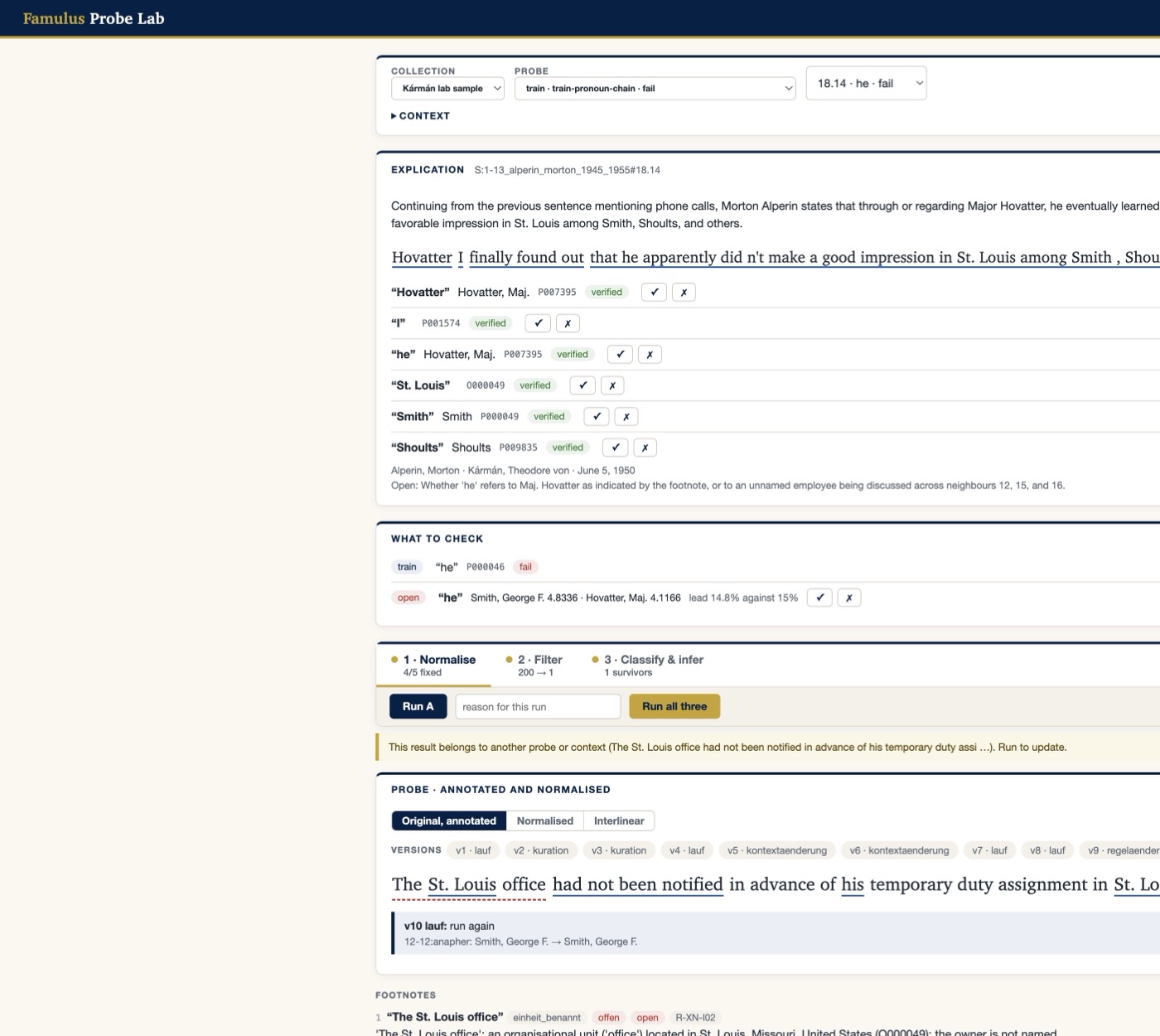
The probe lab is the workbench on which the reading is developed, before it is offered to a reader. A probe is one sentence of a collection, together with what the reading of a phrase in it must be. The lab takes the sentence from a collection that already has a lab sidecar — today the Kármán lab sample and Euler’s E57, 2 collections — and shows what the system makes of it.
The screen keeps to that. A collection, then a probe: the frozen probes with their role and the last pass or fail, the sample sentences of the collection, or a sentence typed in. The explication of the chosen sentence is on the page at once: the meaning, the sentence with its marks, and one row per referent. A mark of correct or wrong on that row is the review. A correct reading, or a wrong referent with the individual it should have been, is written into the probe set immediately, as a guard. A remark about the wording of the explanation stays a note, because a probe cannot test a wording.
The lab runs on this machine. Start it with scripts/satz_viewer.py from famulus-proof; it listens on port 5188, and the platform route is /probe-lab. It is not published, and this page does not offer it as a public address.
Chapter 2
The three modes, and the audit
Three modes read the same probe. Normalise writes the footnotes: what each expression stands for. Filter keeps the sentences of the sample that the footnotes anchor. Classify and infer gives each survivor a verdict against the probe. A mode the collection cannot serve is marked not available. E57 has the sentence sidecar and no fact sample, so filter and classify say so; they are not filled with the Kármán result.
Each mode shows its result and nothing else. Normalise shows the annotated sentence and the footnotes. Filter shows the survivors, marked against the gold, and the funnel line. Classify shows the verdicts. Terms, cross-references, the anchors and the query, the abduction and the confusion matrix sit behind one Details disclosure, with the Partitur inspector and the sample corpus.
Above the modes, the audit names at most five things that decide whether the reading is good, the worst first. An open footnote shows its two best candidates, their scores and the lead against the threshold. A disagreement between the explication and the normaliser on the same phrase is listed. So is each frozen expectation for this sentence, passed or failed. For the filter, a false negative comes before a false positive; for classify, a verdict that differs from the gold. The rest is behind “show all”. A footnote carries the same correct / wrong control as a referent, because the probes test footnotes.
Chapter 3
Learning by comparing
The last card is the comparison. One row per role — train, held-out, guard, book — gives the package rules against the latest candidate. The last full check of the package rules passed 6 of 7 train expectations, 1 of 2 held-out, 19 of 33 guard and 5 of 6 book. So far 3 rounds were run and 0 kept. A candidate is kept only when it loses no expectation that passed and gains one beyond the single sentence it was fitted to.
Two actions run the work. “Run a learning round” asks for one round of revisions to the declared relevance weights, gated by the tests and judged on the probe set. “Recheck probes” reads the probe set again with the package rules. A round that was kept can be adopted as the new package files. Learning from a free instruction is still there, folded away, for a change that is not a weight.
The probe set is not a fixed list. A review verdict on a sentence of the collection becomes a guard at once: correct expects the referent that was shown; wrong, with a correction, expects that individual and excludes the one that was shown; wrong without a correction only excludes it. A later verdict on the same sentence, phrase and occurrence replaces the earlier one. 1 such expectations are in the set now. Sentences the Nachlass reader asked to explicate enter the set as a field probe without an expected person — 2 today; the checker does not score them until an owner verdict names one. A typed sentence that is not a sentence of the collection is not turned into a probe.