
Ancient Sundials

‹ Ancient Sundials

Dialface ID 231

Abstract

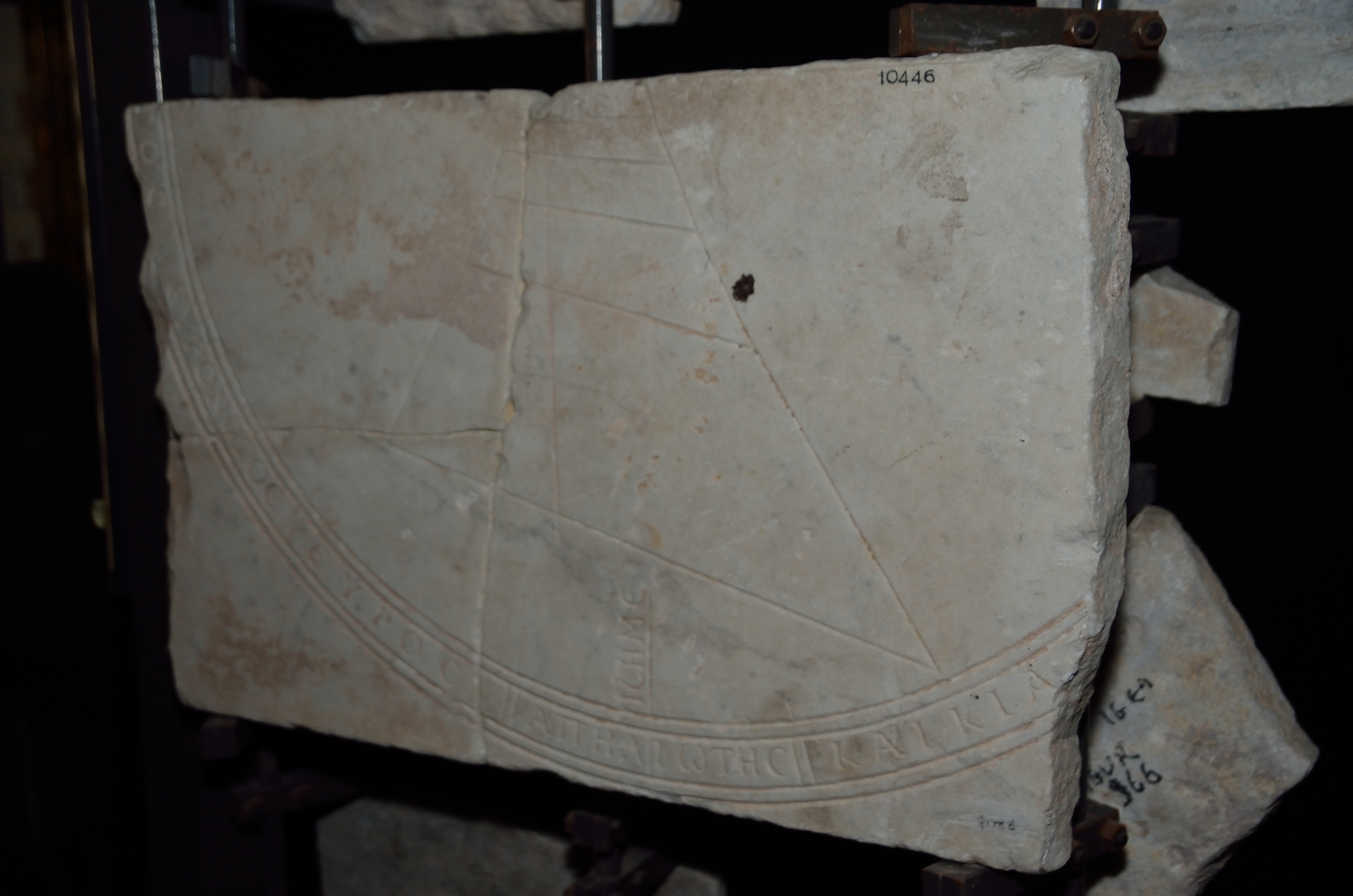
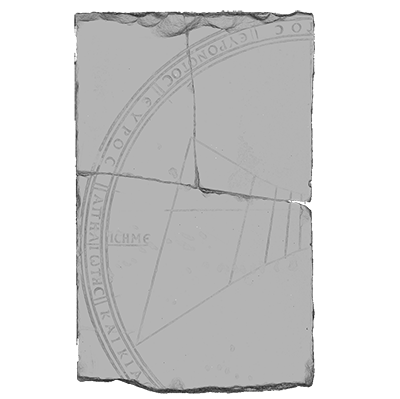
A trace of gnomon hole is preserved along the broken right edge which coincides with the meridian of the dial. No metal remains. Three fragments have been joined to form the left half of a sundial. The equinox crosses and extends a little beyond the six preserved hour lines. Winter and summer solstice curves have been approximated by straight lines. The meridian extends beyond both solstices the length of the diameter of the inner circle.

Measurements

Measurement record: pipeline ObjID 233, matched to this dialface by inventory number.

This object is registered in the measurement database, but its own record holds no measured values.
References

  • – Diels, Herrmann, Antike Technik, Leipzig and Berlin, 1920, p. 182, table 5, 2 (drawing).
  • – Scott Gatty, Margaret, The Book of Sun-dials, London, 1900, p. 45 f.
  • – Gibbs, Sharon L., Greek and Roman Sundials, New Haven and London, 1976, p. 332, p. 352, pl. 55.
  • – 1308 (drawing).
  • – Kenner, Friedrich, Römische Sonnenuhren aus Aquileia, 1880, p. 12.
  • – Lais, P. G., Pubblicazioni della specola Vaticana, Rome, 1894, vol. 4, book 1 (photograph).
  • – Peter, Francesco, Di un Antico Orologio Solare recentemente trovato, Rome, 1815, (drawing).
  • – Winter, Eva, Zeitzeichen. Zur Entwicklung und Verwendung antiker Zeitmesser, Berlin and Boston, 2013, 534.
  • – Bonnin, Jérôme, La Mesure du temps dans l'Antiquité, Paris, 2015, A 163.

3D Models

DOI

10.17171/1-1-2733

Citation

Berlin Sundial Collaboration, Ancient Sundials, Dialface ID 231, Vatican City, Inv. Nr. 10446, 2014, Edition Topoi, DOI: 10.17171/1-1-2733

Citable

Download